7 Benefits of Extended Stay RV Living in California
Practical benefits of long-term stays
Southern California Edison’s average residential rate hit 34.5 cents per kilowatt-hour at the start of 2026 — more than double what many residents paid five years ago. For long-term RV residents at parks like Diamond Valley RV Park in San Jacinto with metered electric hookups, that number shows up on the bill every month. And it’s pushing more of them to ask a question they never expected: is it time to go solar?
The problem is housing. California’s rental market was not built for the reality of how skilled tradespeople actually live: following job sites across regions, sometimes for months at a time, with no interest in signing a 12-month lease for an apartment they’ll leave in 90 days, paying first and last month’s rent plus a deposit on a unit they’ll rarely fully use.
According to the California Employment Development Department (EDD), Riverside County’s construction sector has added thousands of jobs through 2024–2025 and is projected to continue growing through 2027. The workers fueling that growth need practical, flexible housing. A growing number are finding the answer in long-term RV park living.
The answer isn’t one-size-fits-all. RV solar works differently than rooftop residential solar. The economics depend on your rig, your usage habits, your park’s hookup situation, and how much you’re willing to invest upfront. But for residents in San Jacinto — where sunny skies are the norm and electric bills can run $60–$120/month — the math is increasingly worth running
Unlike residential solar, which feeds power back to the grid, RV solar is almost entirely self-contained. Panels mounted on your RV’s roof — or deployed as portable foldable units — generate DC power that flows through a charge controller into a battery bank. An inverter then converts that stored DC power to AC for your appliances, devices, and lighting.
Most full-time RV residents use between 30 and 60 kilowatt-hours per month for basic needs. A 400-watt panel system in San Jacinto — which averages around 5.5 peak sun hours per day — can produce roughly 66 kWh per month in optimal conditions. That’s enough to cover a modest load entirely. For long-term residents with full hookup access, the most practical approach is a hybrid: solar and battery storage cover daily light loads, while shore power handles heavy appliances like air conditioning on demand. Before investing in any solar setup, confirm your park’s specific policies on panel mounting and electrical use.
The RV solar market has matured significantly. Here’s what’s popular among long-term residents:
Renogy offers foldable suitcase-style panels in 200W and 400W configurations starting around $200–$400. These require no permanent installation — set them on the ground, angle toward the sun, and plug into a charge controller. For residents in parks that don’t permit roof-mounted systems, or who want flexibility without commitment, these are the entry point.
Paired with a well-run long-term RV park like Diamond Valley RV Park in San Jacinto — positioned at the center of Riverside County’s most active construction corridor — the economics are clear.
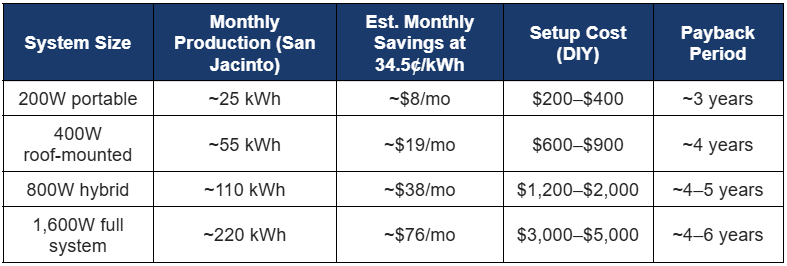
A 400W–800W roof-mounted system, paired with 100–200Ah of lithium battery storage and an MPPT charge controller, can cost $800–$2,000 installed with DIY labor. At SCE’s current rate of 34.5¢/kWh, a system producing 60 kWh/month saves roughly $20/month — paying back in 3–5 years depending on install costs.
Residents running larger rigs — a residential-style refrigerator, regular AC use, home-office electronics — are looking at 1,000W–2,000W of panel capacity paired with 200–400Ah of lithium iron phosphate (LiFePO4) batteries. These systems can run $3,000–$6,000 installed but deliver significant monthly savings.
Note: Production estimates based on San Jacinto’s average of 5.5 peak sun hours per day. Actual output varies with season, shading, and panel angle.
The federal residential clean energy tax credit (30%) applies to solar equipment installed on a primary residence — and RVs can qualify as a primary residence for tax purposes if you have no other home. The CPUC’s Self-Generation Incentive Program (SGIP) offers additional incentives for paired solar-plus-storage installations, targeting low-income and disadvantaged communities — which includes many residents of the Hemet-San Jacinto area.
Residents should check with a tax professional about their specific situation. The IRS definition of a primary residence is broader than many people expect, and documentation requirements are manageable for full-time RV dwellers.
The most honest feedback from long-term RV solar users clusters around a few consistent themes:
How long do you plan to stay? If you’re planning to remain at Diamond Valley RV Park for 3+ years, a roof-mounted system is a strong investment. A 200W portable setup is better if relocation is likely.
What does your electric bill actually look like? DVRP’s metered electric is billed through Southern California Edison — if you’re averaging $45/month, the savings window is narrow. At $90–$120/month, it widens considerably.
For full-time residents at Diamond Valley RV Park, solar is worth the research. It won’t eliminate your hookup costs — but it can meaningfully reduce them. Also see our RV maintenance checklist for long-term residents to keep the rest of your rig running as reliably as your power system.

Practical benefits of long-term stays

A lifestyle piece about what makes San Jacinto a great place to live: affordability, nature, proximity to major cities, and quality of life — establishing DVRP’s location as a selling point.

Compares cost, lifestyle, amenities, and proximity to attractions in Palm Springs vs Hemet for long-term RV residents — positioning DVRP’s location as the best value option.
Looking for a quiet, affordable place to stay? Diamond Valley RV Park is a welcoming community where retirees, traveling professionals, and families enjoy stability, comfort, and connection — with a one-week minimum stay and flexible monthly options.
Diamond Valley RV Park
344 N. State Street, San Jacinto, CA 92583
Office Hours: Monday–Friday, 9 AM – 4 PM
Office: 951-654-0670
Fax: 951-654-6622
Email: info@diamondvalleyrvpark.com