Day Trips From San Jacinto: Exploring Wine Country, Casinos & Desert Resorts
Showcases regional attractions accessible from DVRP: Temecula wine country, Palm Springs, Soboba Casino, Cabazon Outlets — reinforcing the location’s lifestyle appeal.
People who’ve never done it imagine one of two things: either a cramped, dirty camp where people are just waiting on hard times to end, or a sun-drenched paradise of endless leisure. The truth sits comfortably between those extremes — and it’s far more interesting than either version.
Full-time RV park living is a deliberate choice made by retirees, traveling workers, remote employees, people escaping absurd California rents, and everyone in between. What unites them isn’t circumstance. It’s a preference for a different kind of daily life. Here’s what that life actually looks like — the mornings, the trade-offs, the unexpected wins, and the things nobody tells you before you sign a lease.
Nobody walks into a 300-square-foot space after living in a 1,500-square-foot house and feels immediately at ease. The first few weeks involve a learning curve that’s equal parts spatial and psychological. You are recalibrating what you need, what you use, and what you were keeping out of habit.
Practically, this means figuring out systems. Where does the dish soap live? How do you organize so that the thing you need isn’t always behind the other thing? Many new residents describe this as a surprisingly absorbing puzzle — one that, once solved, produces a genuinely efficient living space. The most common advice from long-timers: spend the first two weeks unpacking slowly and ruthlessly, and don’t fill every cabinet on day one.
The emotional adjustment is different. For some people, the reduction in space triggers an unexpected sense of freedom. For others, especially those who built identity around their home, the first month can feel like a loss. Both reactions are normal. The residents who thrive tend to be those who shift their mental picture of “home” from the square footage to the community and the lifestyle surrounding it.
What most people don’t expect: the quiet. In a managed, gated park with community norms, noise levels are typically lower than in an apartment complex where walls are thin, and neighbors change constantly. You own your space — your porch, your mat, your awning — and so does everyone else.
One of the most underrated aspects of RV park living is the rhythmic quality of daily life. There are no landlords knocking, no HOA meetings, no property tax notices. You wake up, and the first decision is often something like: coffee outside or inside?
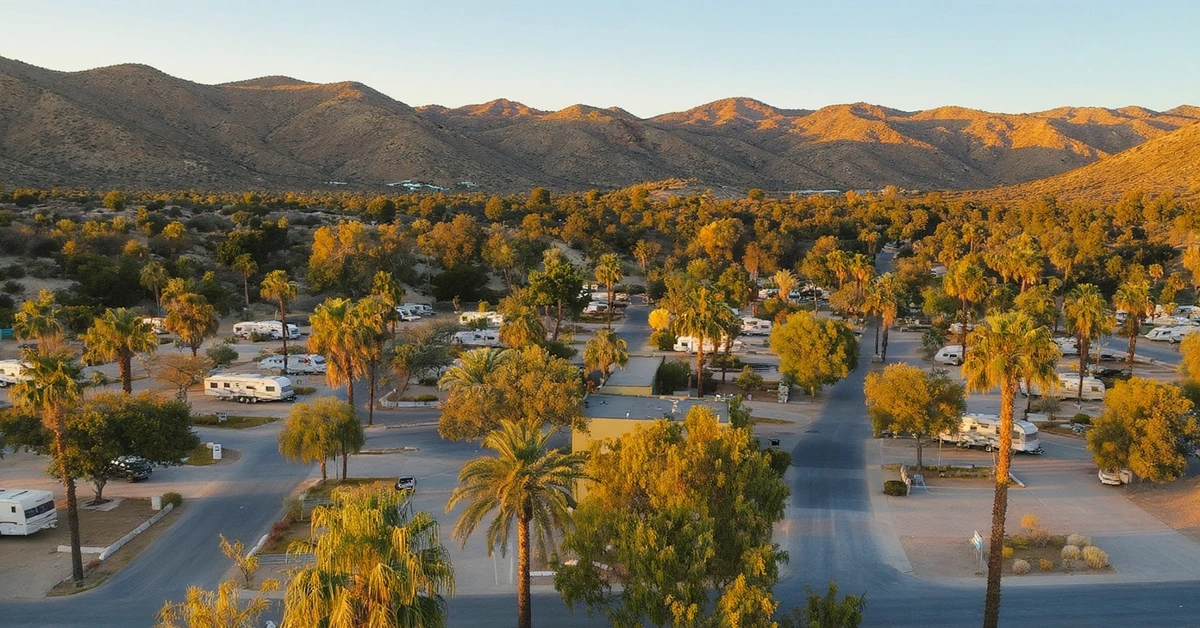
Mornings in a well-run park are genuinely pleasant. If you’re at a place like Diamond Valley RV Park in San Jacinto, you’re looking at 300+ days of sunshine per year. You can have coffee on your step with Mount San Jacinto visible on clear mornings. Dogs get walked on set paths. Neighbors wave. It sounds like a cliché because it actually happens.
The pool and spa become part of the routine in ways that surprise people. It’s not vacation-pool energy. It’s Tuesday-afternoon-because-why-not energy. Residents who work remotely often structure their day around a mid-afternoon swim. Retirees gather in the spa after walks. These spaces become social infrastructure, not amenities.
Evenings slow down. Clubhouse events — card nights, potlucks, seasonal gatherings — give the week a social skeleton without requiring much effort. You show up, or you don’t. No RSVPs, no obligations, no social debt. That low-pressure quality is something full-timers consistently cite as one of the things they didn’t know they needed.
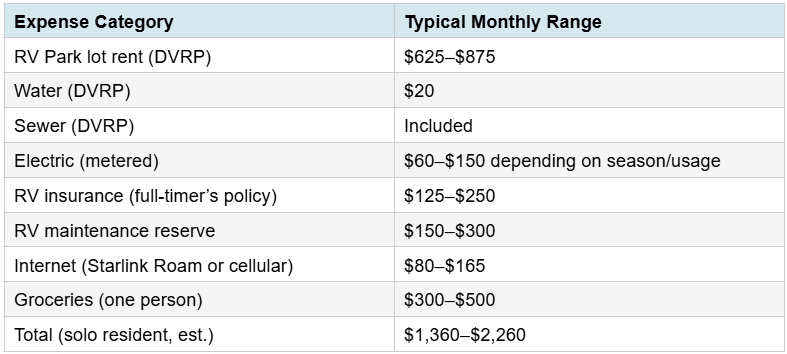
The financial picture of RV park living is the part most people get wrong before they move in. The monthly site fee is just the beginning — but in a managed park, it’s also the dominant number.
Compare that to the median one-bedroom rent in the Riverside-San Bernardino metro, which hit $1,959/month in 2026 according to the Riverside-San Bernardino County Community Indicators report, before utilities, renters’ insurance, or internet. The math favors RV living, especially for anyone on a fixed income or managing a tight budget in Southern California.
What the numbers don’t show: the elimination of surprise costs that come with renting. No rent increases mid-lease at a park with a monthly agreement. No unexpected $400 repair bills charged back to you. No first-and-last-and-deposit that locks up $4,000–$6,000 of liquid cash before you even move in.
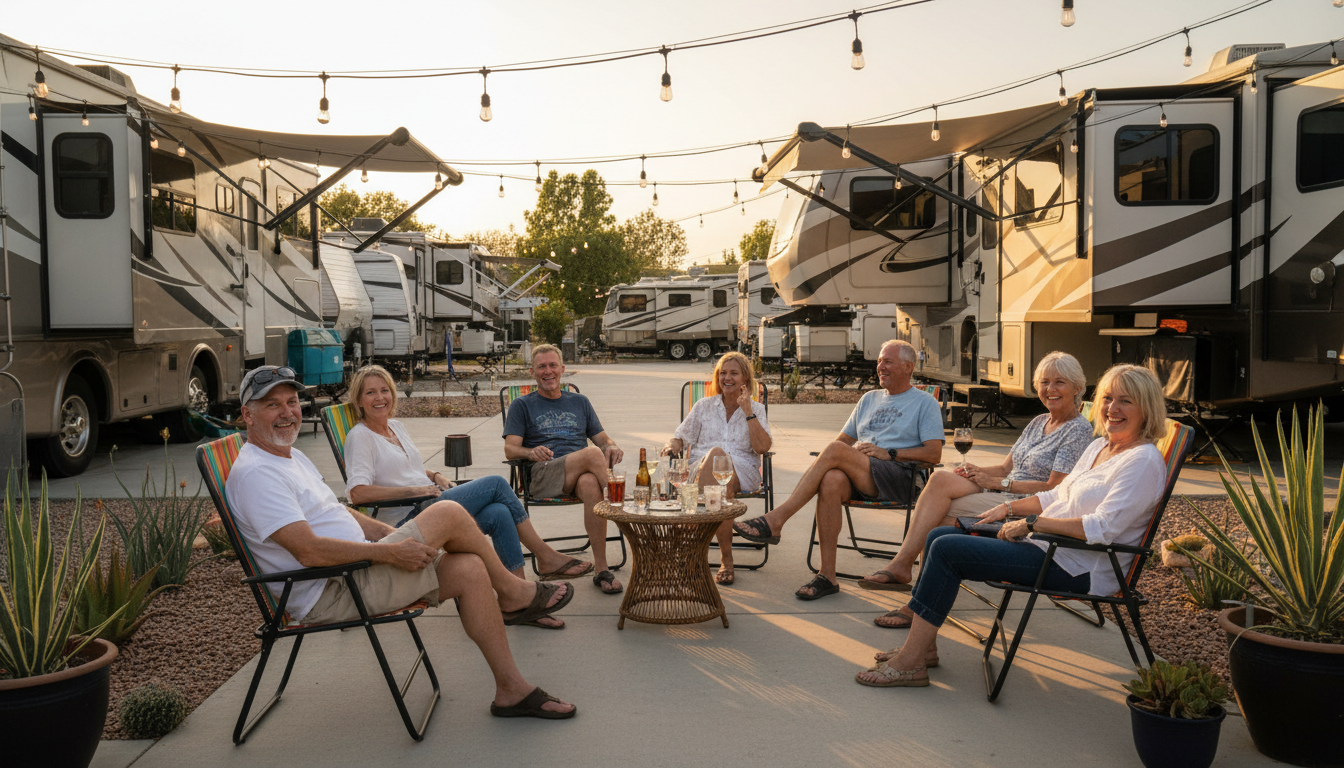
Ask long-term RV park residents what surprised them most, and a disproportionate number say: the people. Not in a forced or sentimental way, but in the sense that geographic proximity combined with shared lifestyle choices produces a strikingly efficient community.
In an apartment building, you may live next to someone for two years and never learn their last name. In a managed RV park, your neighbors know when you come home, notice when you’re gone, and will flag you down to tell you your awning is out before a storm rolls in. There is a baseline level of watchfulness that functions as informal security and informal community simultaneously.
This matters especially for solo residents, retirees, and people new to an area. A park is — at its best — a ready-made social fabric. You don’t have to build it from scratch. You arrive, and it’s already there, and you can plug in as deeply or as lightly as you want.
No housing type is without compromise. Here are the honest trade-offs residents consistently name, and how most of them adapt.
You cannot keep everything. Storage requires constant, active curation. Most long-timers report that after the first purge — which is often emotionally difficult — they stopped missing things almost immediately. The discipline of owning only what you use turns out to be self-reinforcing.
You can have visitors, but the logistics are different. A couch doesn’t hide a guest comfortably for a week. Residents who entertain frequently tend to use the park’s clubhouse space or plan shorter visits. This isn’t a dealbreaker for most, but it’s a real lifestyle shift.
This is not an apartment. The RV itself — roof seals, slide mechanisms, water heater, tires — requires ongoing attention. Residents who stay ahead of maintenance on a regular schedule avoid the expensive surprises that catch unprepared newcomers off guard. A monthly maintenance habit isn’t optional; it’s part of the cost structure.
Full-time California RV park residents need a stable mailing address for DMV registration, banking, and official correspondence. Many use a mail forwarding service, a trusted family member’s address, or the park address directly. It’s a one-time administrative task that sounds complicated and is actually resolved in an afternoon.
After talking to long-term residents across multiple parks, a pattern emerges. The people who thrive share a handful of traits: they are comfortable with compact spaces, they value community without requiring it, and they are genuinely done with the overhead of traditional housing. They’re not running from something — they’re running toward a simpler, more intentional version of daily life.
The people who struggle tend to be those who moved primarily for financial reasons, without genuinely wanting the lifestyle change. If you’re moving into an RV park hoping to eventually get back to a house, you’ll find the adaptation harder. If you’re moving in because you actually want this — the community, the simplicity, the lower overhead — you’ll probably find that the reality is better than the idea.
Diamond Valley RV Park is a 1-week minimum, long-term community — not a campground. Residents are neighbors, not transients. If you’re curious about what daily life looks like on-site, visit diamondvalleyrvpark.com or read more about what extended RV living in California looks like.

Showcases regional attractions accessible from DVRP: Temecula wine country, Palm Springs, Soboba Casino, Cabazon Outlets — reinforcing the location’s lifestyle appeal.

Practical seasonal maintenance guide for long-term RV residents: roof checks, seals, plumbing, electrical, and pest prevention. Establishes DVRP as a knowledgeable, caring partner.

Practical tips for remote workers and digital nomads choosing RV life: connectivity, routines, workspace setup, and why a stable long-term park beats constant travel.
Looking for a quiet, affordable place to stay? Diamond Valley RV Park is a welcoming community where retirees, traveling professionals, and families enjoy stability, comfort, and connection — with a one-week minimum stay and flexible monthly options.
Diamond Valley RV Park
344 N. State Street, San Jacinto, CA 92583
Office Hours: Monday–Friday, 9 AM – 4 PM
Office: 951-654-0670
Fax: 951-654-6622
Email: info@diamondvalleyrvpark.com